Blog
Guides on Generative Engine Optimization (GEO) — how to get your brand mentioned and recommended by AI assistants like ChatGPT, Google AI Overviews, Gemini, Claude, and Perplexity.

How to Get Your Brand into Google AI Overviews
AI Overviews is not a chatbot: it is the AI answer at the top of Google's results page, built from pages that already rank and shown only for some searches. Here is how it picks its sources, why absence is a measurement of Google and not of you, and the playbook for earning a place in it.

Mentions vs Citations: The Goal Isn't to Be Linked. It's to Be the Answer.
AI search has two currencies: citations and mentions. They get conflated in every GEO conversation, and most brands optimize for the wrong one. Why mention share is the senior metric of the GEO era — and why you can't publish your way into it.
SEO to GEO: The Market Shift, in Numbers
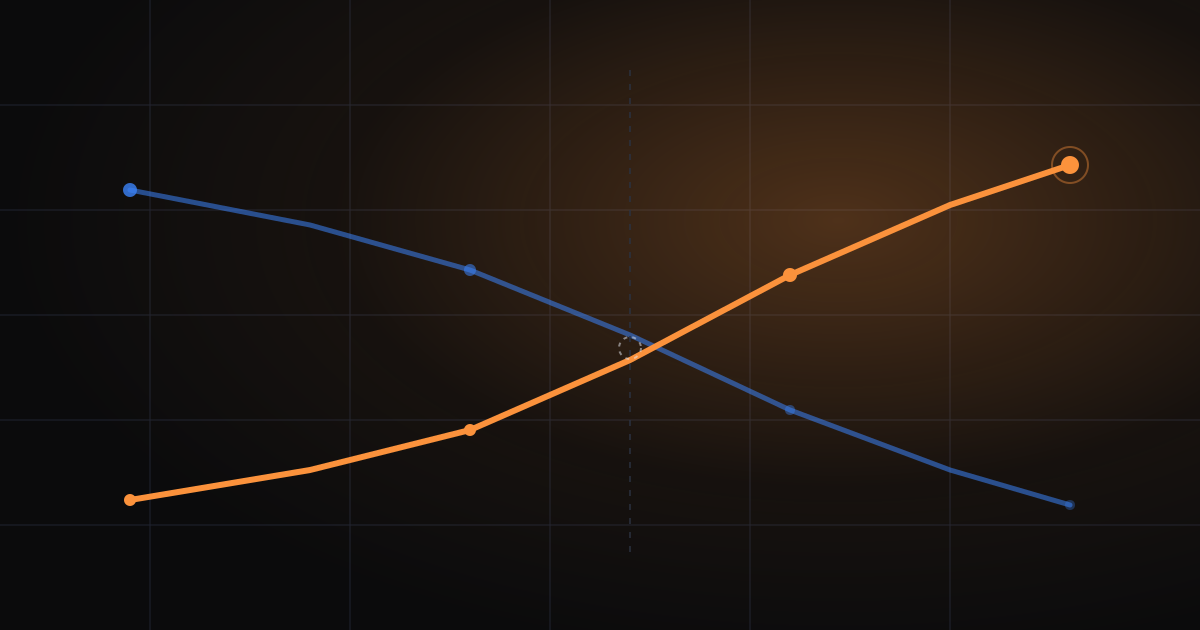
Traditional search volume is falling, zero-click answers are the norm, and AI-referred visitors convert 4.4× better. The data behind the shift from ranked links to generated answers — Gartner, Bain, Pew, Semrush, and a 1M-keyword study, 2024–2026.

The AI Visibility Audit: A 10-Step Checklist
An AI visibility audit checks whether AI assistants can find, understand, and recommend your brand. Work through these 10 steps — from a no-JavaScript crawl test to competitor share-of-voice — to find exactly where you're losing AI answers.

How to Get Cited by Perplexity (and Other AI Search Engines)
Perplexity cites pages it can retrieve, parse, and quote: crawlable content that directly answers the question, corroborated by other sources it trusts. Here's what actually drives AI citations — and how to earn them for your brand.
What Is Generative Engine Optimization (GEO)?
Generative Engine Optimization (GEO) is the practice of improving how often and how favorably your brand appears in AI-generated answers from ChatGPT, Gemini, Claude, and Perplexity. Here's how it works and why it matters.

How to Rank in ChatGPT and Other AI Search Engines
To rank in ChatGPT and AI search, make your brand easy for models to describe, build consistent third-party mentions, publish answer-shaped content, and measure your visibility across every assistant. A practical step-by-step guide.

AI Visibility vs Traditional SEO: What's Actually Different
Traditional SEO competes for a ranked position on a results page; AI visibility competes for a mention inside a synthesized answer. They share foundations but differ in the unit of competition, how results are measured, and how fast they change.